Facebook Inc (FB.O) began a Europe-wide campaign on Monday to thwart extremist posts on social media, after German politicians in particular raised concerns about a rise in xenophobic comments linked to an influx of refugees.
The U.S.-based group launched its "Initiative for Civil Courage Online" in Berlin, pledging over 1 million euros (1 million pounds) to support non-governmental organisations in their efforts to counter racist and xenophobic posts.
Facebook Chief Operating Officer Sheryl Sandberg said hate speech "has no place in our society", including in the Internet.
Facebook's ground rules forbid bullying, harassment and threatening language, but critics say it does not enforce them properly.
On Friday, the firm said it had hired a unit of the publisher Bertelsmann to monitor and delete racist posts on its platform in Germany.
In November, prosecutors in Hamburg launched an investigation into Facebook on suspicion of not doing enough to prevent the dissemination of hate speech.
Top German politicians and celebrities have voiced concern about the rise of anti-foreigner comments on Facebook and other social media as the country struggles to cope with a tide of new migrants that amounted to 1.1 million last year alone.
Chancellor Angela Merkel has urged Facebook to do more, and the Justice Ministry set up a task force with Facebook and other social networks and Internet service providers with the aim of identifying criminal posts more quickly and taking them down.
Google has revealed that in order to achieve its goal of building a self-driving car that can be produced in enough numbers to make it a viable proposition for consumers.
Peter Krafcik, who heads Google’s car project, told an audience of automotive industry figures in Detroit last week: “The message is that we understand... we are going to need a lot of help in the next stage of our project. We’re going to be partnering more and more and more: you can count on it, though I don’t have anything certain to say today.”
There has been speculation that Google and Ford were going to do a deal on production of the revolutionary car, but this has been denied by both companies. Krafcik was also non-committal when asked whether he had recently met with General Motors (GM).
Krafcik, a previous employee of GM, said that Google had major gaps in its knowledge that it would need to build a production car.
“Automakers have a track record of producing cars at scale,” Krafcik said.
“As work progresses, we look forward to working with many of you people as we bring this technology to market.”
He added that the company had to “figure out the right set of partnerships” and that it was currently too early to say whether Google would work with more than one car manufacturer on a number of vehicles, or with a single carmaker on one model.
We’ve just been delighted, honestly, by the amount of inbound interest in the programme
Peter Krafcik, Google car project
“We’ve just been delighted, honestly, by the amount of inbound interest in the programme,” he said. “Every [carmaker] has been wanting to speak to us.”
Krafcik also explained how Google had decided that vehicles had to be completely self-driving, while the traditional manufacturers are working on the basis that drivers will want to take over in difficult situations.
He explained how the cars were gaining experience in dealing with a wide range of scenarios on the road in testing around the company’s headquarters in Mountain View, California, and also in Austin, Texas.
Even some that no automated car could be prepared for.
For example, one car had to deal with an encounter involving a woman in a mobility scooter chasing a duck around a road with a broom.
Understandably, the vehicle’s software contained no specific algorithm to cope with such a situation, but it had slowed down and observed the situation until it understood what was going on.
If your iPhone 6S seems to be displaying the incorrect battery percentage, it could be affected by a known bug.
Apple says it is investigating an issue with its iOS software that appears to be preventing the battery percentage icon from accurately updating on the iPhone 6S and 6S Plus. The problem has lead some users to believe they have more battery power remaining than they do.
Shortly after the iPhone 6S and 6S Plus were released in September, it emerged that different versions of the phone had varying battery life, depending on which of two chip variations they had inside. Apple admitted that this was possible, but said the difference in battery life was only between 2 percent and 3 percent.
This latest battery issue might be superficially misleading, but it ultimately doesn't affect the total amount of juice you can get out of the phone on one charge.
The problem seems to be closely linked to the iPhone's clock and is in particular affecting users who have recently traveled through several time zones or manually adjusted the time on their device.
"This was happening to me but I figured out it was me changing the system time. It was freezing the battery percentage. Hasn't happened to me since I stopped changing the time/date," said Reddit user Sonnyspak.
Apple said it "is aware of this issue and is investigating the cause and a solution." In the meantime it advises users affected by the problem to reset their iPhones and then go to Settings > General > Date & Time and ensure that "Set Automatically" is turned on.
It's unknown how many users have experienced the problem. Apple usually pushes out fixes to such issues in the next iteration of its iOS software, but the company has not said when we can expect to see this.
Apple did not respond to request for further comment.
A malware campaign specifically targeting businesses and customers using the WhatsApp messaging app has been uncovered.
Cybercriminals are sending emails that spread malware when clicked. Craftily disguised as genuine WhatsApp content, the emails contain an attached zip file with malware.
Comodo Antispam researchers first discovered the phishing scam, which uses a number of different email subjects, including “an audio memo was missed”, “you have obtained a voice notification”, and “you’ve recently got a vocal message” to lure victims to click:
“Cybercriminals are becoming more and more like marketers—trying to use creative subject lines to have unsuspecting emails be clicked and opened to spread malware,” wrote Comodo’s director of technology Fatih Orhan in a blog post.
The messages appear real to users, because the rogue email address is disguised with an umbrella branding name “WhatsApp”.
WhatsApp, bought by Facebook for $19bn in 2014, currently has close to 1bn users worldwide.
The Apple TV is a great networked media player, but it would be greater still if it supported more file types and played from more locations. By locations, I mean over the network from something other than an iTunes server, and—oh, I don’t know—an attached USB drive?
Well, there’s no help for the latter at the moment, despite the USB-C port on the latest model, but there is a viable and completely free alternative for playing a variety of media types over the network: VLC, or the VideoLan Player.
VLC is well known throughout the computing universe. On Windows, it’s just one of several options for playing variegated file types. On the Mac and Linux, the best of very few. On Apple TV it’s a welcome addition that obviates the need to pony up cash for anything on the rather abbreviated list of flawed products (Playable, OnePlayer, 8 Player, etc.) and Plex, which requires an account.
Is VLC for Apple TV (called VLC for Mobile in the App store) perfect? No. Does it work? Yes. Quite well. At least with audio and video. In my hands-on, it didn’t want to display image files, though it did list them and create thumbnails. I’m thinking that’s a bug and expect that it will soon be fixed.
VLC
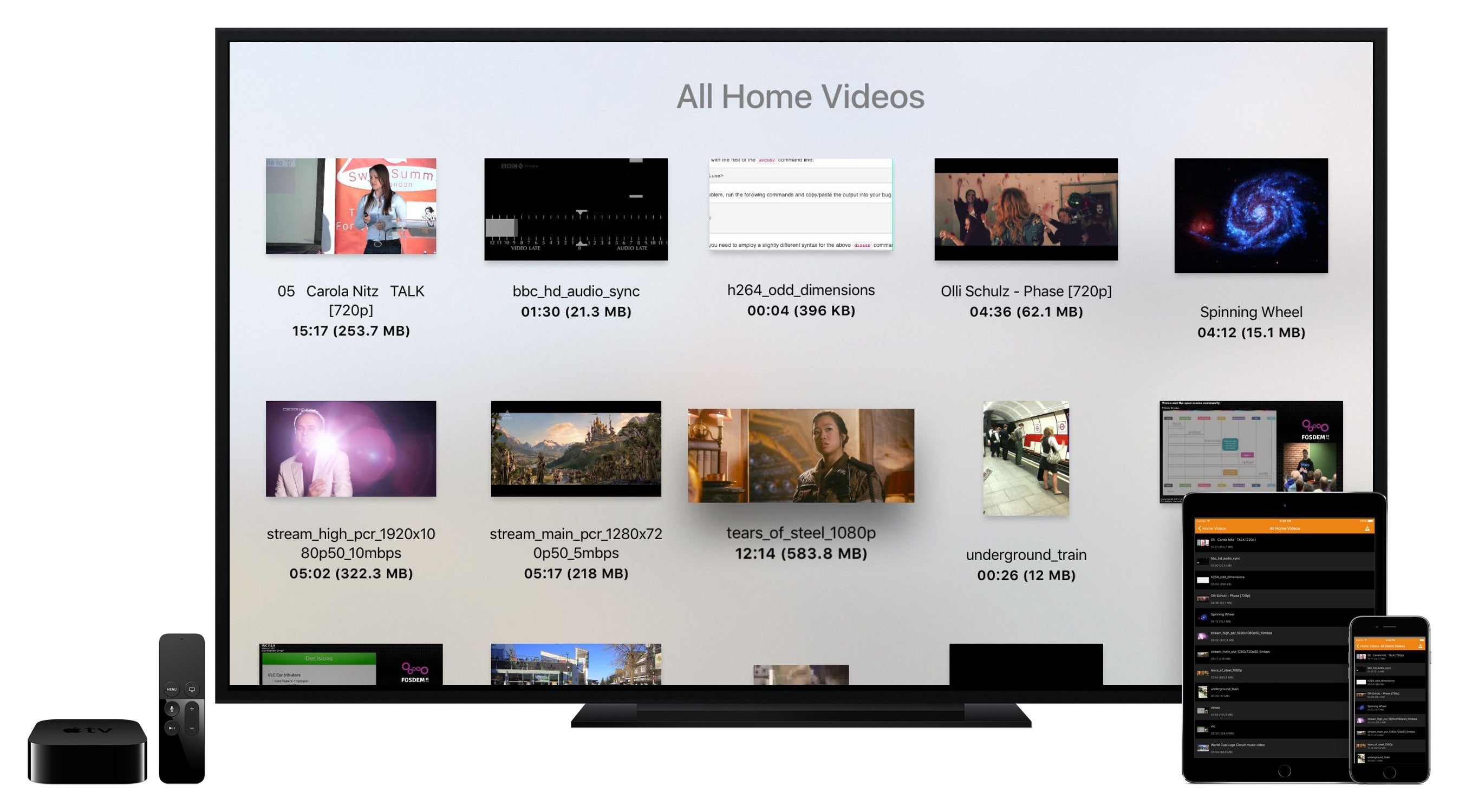
VLC on Apple TV browsing files on an iPad
Excellent format support
Audio support was nothing short of fantastic. In addition to the usual M4A, MP3, and WAV support, VLC also played both Apple Lossless and WMA Lossless, APE, FLAC, OGG, and even Opus. It also played 5.1- and 7.1-channel surround sound. Wow.
Video support was almost as good. VLC for Apple TV understands HEVC and UHD (3840 by 2160, or 2160p), but successful playback was limited to 1080 and frames per second to 30 for reasons undetermined. When working within those limitations, VLC handled MP4, WMV, FLV, OGG, QuickTime, and just about everything else; even some old Real Media formats. That’s not surprising as all the versions of VLC use internal codecs for just about everything. The one notable fail was MKV files—one 500MB, the other 30GB. Either it took too long to cache, or there was another issue.
But even MKV played fine when I streamed it to VLC using DLNA. My NAS boxes offer DLNA, and so does Windows Media Player. Files from WMP weren’t enumerated perfectly right off the bat, but that might just as easily been WMP as VLC.
APPLE
Thanks to VLC, Apple TV now supports nearly every audio and video file format you can find. For free. And from any network device.
Interface
On Apple TV, VLC comes closer to acting as its name implies than on any other system. Rather than simply presenting you with a player, then forcing you through arcane menus to retrieve media from a network resource, it immediately pops up with the local network resources. Cool.
In my case, that’s several PCs and Macs, plus three NAS boxes. Yes, I have a lot of stuff. VLC understands the SMB (Server Message Block) networking protocol used by Windows, AFP (Apple File Protocol), and the aforementioned DLNA (Digital Living Network Alliance) media-streaming standard, so any device using those (in other words, just about everything in the universe) will show up. This is all done independently from Apple Home Sharing, which is limited to iTunes instances with it enabled. VLC can also play files stored locally on the Apple TV box.
Perfection deferred
Okay, the capabilities are there, and VLC works pretty darn well. It still suffers some of the same minor issues it does on other platforms. First off, I wouldn’t exactly call it ugly, but it’s certainly not the prettiest child in the Apple app family.
It also had the image display bug I mentioned earlier, and didn’t always fail politely on a bad or unknown file. It never hung the unit, as some other players I’ve tested have, but it would be nice to receive notification that it didn’t understand a file rather than the impolitic skip to the next file you do get. I also had some issues with it not re-selecting the proper folder in the list; i.e., the one I just exited from.
Get it
None of those annoyances matter much when all of a sudden your Apple TV box can play virtually any file from any of your devices without any cash outlay on your part. That’s a nice upgrade right there. In fact, Apple ought to thank the VLC folks for so drastically expanding the capabilities of its box. Since it probably won't: Thanks VLC folks!